Matador Nights

Japan’s Obsession With Fire: 6 Things You Don’t Want to Miss

Print This Post Print This Post       Written by Turner Wright

Above photo by EdenandJosh .

To anyone who’s ever gone camping while traveling, the alluring effect of a fire is all too familiar.

People gathered around its flames, taking turns dropping a tiny amount of water (or liquor) into its path, stretching their legs ever closer in attempts to seize the heat and capture its awesome energy.

It provides a sense of community. Swapping travel stories. Sharing drinks. Making smores (how internationally known are those, by the way?).

From dragon tales, to rites of purification, to a prominent mention in the 4th book of Harry Potter, fire plays a larger role in world culture and history than most would believe. Even in this modern age, with bonfires replaced by central heating and its light by alternating current, this common chemical reaction is literally larger than life.

In Japan, for example, one can bear witness to the…

1. Umbrella Burning Festival

Photo by Turner Wright.

By far the most unusual expression of fire I’ve ever had the chance to observe.

Once upon a time, nearly 900 years ago, two brothers by the name of Soga led an attack in the middle of the night against their adversary. Apparently unable to secure torches for the journey, they took to using the closest objects available, paper umbrellas, to light their path of vengeance.

This festival, the Soga Don No Kasayaki (そがどんの傘焼き), is celebrated in the southern city of Kagoshima (and Odawara, closer to Tokyo), the Naples of Japan, a city blessed with a beautiful landscape and some legendary hot springs.

In late July, residents gather along the riverbank to bear witness as a large stack of paper umbrellas is burned to the ground, accompanied by dancing, shouting, history lessons, and demonstrations of strength.

2. Fire Foods

Yakitori (焼き鳥)

Grilled chicken on a stick, available at many supermarkets and most festivals and open-air markets.

Takoyaki (たこ焼き)

Fried pieces of dough filled with mayonnaise and a piece of octopus… isn’t it helpful to read Japanese?

Yakiniku (焼き肉)

The cream of the crop, Japanese BBQ. A variety of meat grilled over an open flame and served on a bed of rice. Quite sweet and savory.

3. Flower Fire

Photo by Turner Wright.

Shigeru Miyamoto wasn’t too far off giving a mustachioed plumber from Brooklyn the power to shoot fire from his hands upon contact with a very special flower.

Fire flowers.

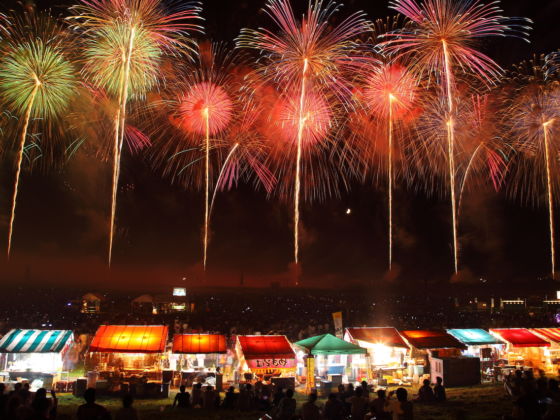
Flower fires, from the Chinese characters 花火, or, in layman’s terms: fireworks.

The 4th of July celebrations on American soil would be put to shame by many of the festivals across Japan in the month of August. Each prefecture, each city, strives to be the best, boast the biggest number of explosions in the sky, the loudest cracks, the most intense flames….

Try walking anywhere in Japan at the end of the Obon holiday (honoring the dead) and not see Japanese in their light summer yukata or kimono, wearing geta (wooden shoes), and on their way to an all-day celebration of food and drink before twilight sets in and the sky is ablaze.

Of all the locations I’ve seen firework celebrations in Japan, I prefer the island of Miyajima with the famous floating shrine. Be careful to escape quickly, though, because you could easily miss the last train to Hiroshima in the back of a 300,000+ crowd.

4. The Volcano is Lit… On Purpose

Photo by EdenandJosh.

Mt. Aso, or Aso-san as it is read in Japanese, was once one of the largest volcanoes in the world.

If you’d have glimpsed it thousands of years ago, it would have been a vision to make even Dante nostalgic for the 9th circle: dozens of smaller eruptions, venting the pressure from the larger magma source, yellow sulfur scattered across the landscape, burning blue just at the edge of the tree line… these explosions eventually occurred too quickly and frequently, causing the entire mountain to collapse in on itself, creating the largest caldera in history.

Locals see the peaks of Aso as resembling a sleeping Buddha, with the active peak, Nakadake, his navel.

An image of such harmony, belying the essence of the mountains, explains much of the culture: fire festivals are held every year to pay homage to this awesome force, fields burned to form one of the largest kanji (Chinese characters) on the planet, nearly 350 meters in length: 火.

Have you guessed it?

FIRE.

The Hifuri Shinji festival, held around the same time of year, is just as impressive, though on a smaller scale.

Participants, professionals, and tourists light torches in front of the Ichinomiya Aso Shrine and set them spinning in circles, creating literally what Johnny Cash meant figuratively: a burning, burning, burning ring of fire.

The act of setting the fire loose, or flinging the fire, as it were, is meant to ensure a good harvest in the coming months and to celebrate the union of the gods.

5. Firewalking

Photo by forward.

Purification by fire is a common belief amongst certain sects of Buddhism. On the island of Miyajima in mid-November, one can watch in angst as priests shuck their sandals and brave a river of hot coals, cleansing the body as well as the soul through pure flames.

Walking on coals isn’t as painful as some would have you believe; unless you’re standing in one place on them for more than a few seconds, it’s unlikely you’ll feel anything more than a warm tingling sensation… coal is not particularly conductive.

6. In Your Own Neighborhood

If you happen to be spending time in Japan in early-mid January, be sure to take advantage of the Tondo Festival. At the lunar new year, neighbors gather to light a huge bonfire and share stories, sake, and mochi (Japanese rice cakes, traditionally eaten at the new year).

Although the Tondo is more commonly attended by residents, I seriously doubt there would be any hesitation over letting a friendly visitor partake in the festivities. All in good fun, in the spirit of celebration.

How have you observed other cultures using fire? Share your stories.

Turner Wright

Turner Wright is a marathon runner first, an adventurer second, and a writer through it all. He has a BS in Aerospace Engineering from the University of Texas at Austin, has been living in Japan for two years, and will soon be headed for China and Thailand. Check out his blog, Keeping Pace in Japan .

| Stumble it!

Get Matador by Email


Jump To Category:


Explore the Community


Latest Community Blogs

  • In the last 48 hours, Canada has plunged into the most exciting political drama of my lifetime. Our new government, elec...
    » posted on 29 November 2008
  • Your friend just returned from the trip of a lifetime - traveling around remote regions, being invited into homes of loc...
    » posted on 29 November 2008
  • Best way to see the city is with a native New Yorker on a walking tour.http://www.walkingtoursmanhattan.com...
    » posted on 1 December 2008

Blogroll